Showing posts with label rates. Show all posts

Thursday, July 28, 2016

The three act structure for motivating mathematics

I hadn't checked into Dan Meyer's blog dy/dan for a while (basically since my calculus days), but I am very glad I did. He has a whole category of problems that he has labeled 3act --- meaning that there is a three act structure to the activity. (You can find all these problems at http://blog.mrmeyer.com/category/3acts/.) To quote Dan,
There are three steps:
  1. Invite students to try a task that is intuitive, but inefficient or inaccurate.
  2. Help them understand some math.
  3. Invite them to re-try the task and see that with math it’s more efficient and accurate.
A really good example that I can use with my sixth graders is the Nissan Girl Scout cookies activity  where you watch a video that advertises the capacity of a Nissan trunk by stuffing it full with boxes of Girl Scout cookies and then estimating the total number of boxes.

Nissan Girl Scout Cookies – Act One from Dan Meyer on Vimeo.

I was wondering how to use this type of idea (make a prediction, focus on math tools that can help, and then test the prediction) using decimal arithmetic. It struck me that one of the best places you can find decimals in the real world is gas stations, and --- sure enough --- the gas station near me shows both gallons and dollars per gallon to the thousandths place.

So here's my question: how do gas stations figure out your cost to the penny? If I wanted to make the most money from my gas station, I would always round up, but perhaps some gas stations are playing fair and rounding to the nearest penny. I'm thinking of a project where I show some pictures of pumps and charges and ask students how to get the final hundredths place.

Thursday, July 21, 2016

Pokémon Go problems for 6th grade math

I've been playing far too much Pokémon Go recently, but assuming the game stays popular, it's fantastic for generating math problems. Here's what I've thought of so far.

Multi-digit long division problems: 

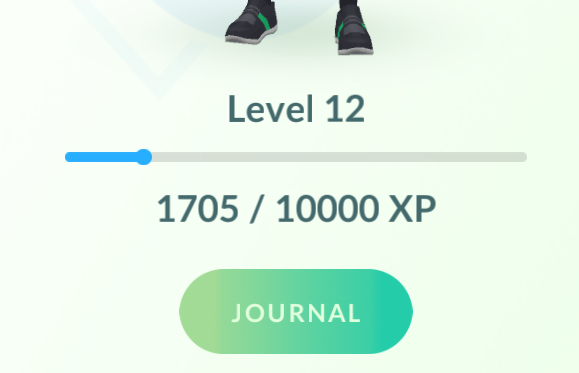
  • To reach the next level you need to earn 10,000 experience points total. If you have already earned 2,350 points, how many Pokéstops do you need to visit (at 50 XP per Pokéstop) to reach the next level?
  • To reach the next level you need to earn 10,000 experience points total. If you have already earned 2,350 points and are a curveball champion (so you can catch already caught Pokémon for 100 XP), how many Pokémon do you need to capture to reach the next level?
Decimal division problem:
  • To hatch an egg, you need to walk a total of 5.0 kilometers. You have walked 0.8 km so far, and can do laps on a waling path that is 1.2 km long. How many laps will you have to do to hatch the egg?
Rates, proportions, and percentages:
  • The picture below shows the progress bar to level up. On my phone it is 450 pixels wide. Based on the picture, what percentage of 10,000 points has been earned so far? How many pixels have been shaded to show the progress?

Decimal arithmetic and unit conversion:
  • What is the difference in weights and heights for the two Raticates shown below? How much would each weigh in pounds (if 1 pound equals 0.45 kg)? How tall would each one be in inches (if 1 inch = 2.54 cm)?

Statistics: 
  • Pick a Pokémon that you (or the class) have many of. (For example, Pidgeys or Rattatas.) Find all the weights for the Pokémon you have and find the mean and median. Create a dot plot, a box plot, and a histogram. Try to figure out which Pokémon are labelled XS (or extra small) and XL (or extra large). 
That's what I've come up with so far --- if you have more ideas, let me know!

Tuesday, July 19, 2016

Teaching concepts and not JUST procedures

Last week, our district hosted some PD based on getting 5th grade and 6th grade math teachers together and collaborating. During the workshop, the organizers emphasized again and again the importance of teaching mathematics on a conceptual level as opposed to just teaching procedures.

Here's an example: if I want to see which fraction is bigger, 13/24 or 7/12, I can use the butterfly method (also known as cross multiplication) to multiply 13 by 12 and 24 by 7 and compare the results. But if I do this, I am not really engaged with the fractions at all. I haven't learned anything new about either fraction, and my answer wouldn't help me put either on a number line. If I at least rewrite the second fraction and realize that 7/12 = 14/24, I have a natural way to determine which fraction is bigger that uses the fractions themselves and not somewhat unconnected whole numbers. Here, the butterfly method is a procedure that may obscure the conceptual understanding that comes from using equivalent fractions.

Well, once I started thinking like this, I started seeing procedures trumping conceptual understanding a lot more. For example, there's a great paper in the NCTM journal Mathematics Teaching in the Middle School called Saving Money Using Proportional Reasoning. It's by Jessica de la Cruz and Sandra Garney and outlines tasks that would make a great project after discussing rates and proportions. Instead of emphasizing cross multiplication, the authors emphasize unit rates and equivalent fractions (which are both hugely important in 6th grade Common Core). Here's a great picture from their article about why cross multiplication can give confusing answers:

What exactly is a dollar-pound?
I was doing some more searching on the potential harmfulness of teaching cross multiplication and found the wonderful site www.nixthetricks.com and the free 83 page book that you can download here. It's written by Tina Cardone, and it's full of tricks that math teachers use, the potential harm those tricks may do, and how you can reteach using conceptual understanding. I particularly loved this flowchart on determining if something is a trick:

How often do you hear "Because ____ said so"?
I'm pretty sure I will switch up how I teach dividing fractions just because I read this book (and hopefully will avoid over-reliance on "Keep-Change-Flip"). If you are looking for deeper understanding by your students, this is a good place to start.